Monday, June 10, 2019
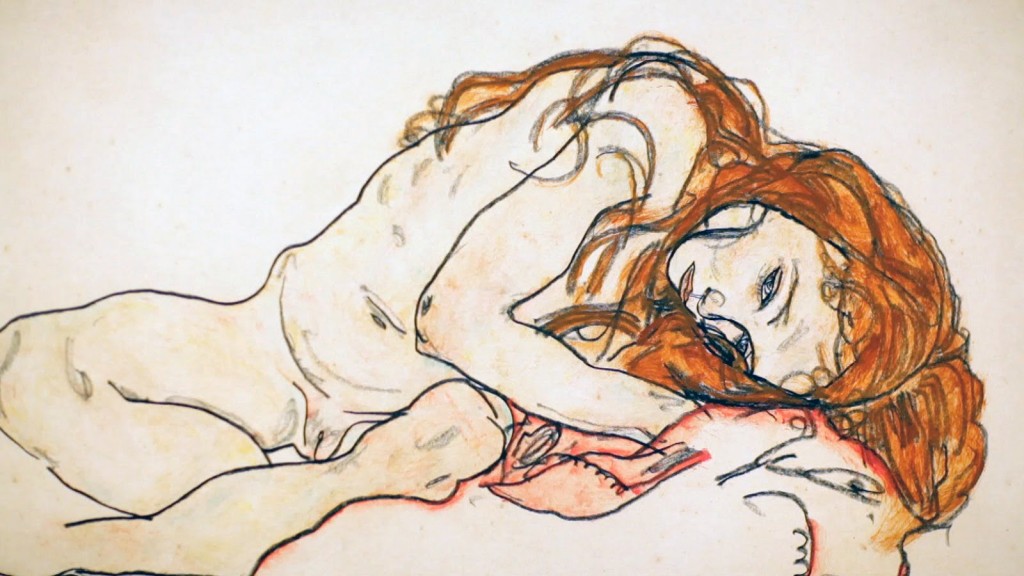
Egon Schiele is one of the most famous Austrian expressionist painter, born in 1890 in Tulln, a small town near Vienna. He expresses a real talent for drawing since he’s a child. He depicts the body in all its shapes and has been at the center of a number of controversies due to his erotic representations. He flays the bodies and brings out their weaknesses and strengths. The sharp line seems to be an iron wire writhing with expressiveness and revealing the intimate secrets of his host, disarticulated. In his work, the nude occupies a very important place: fascinated by the human body, by its precariousness and by the impulses of which it is the object. The woman body inspired him and he the models took positions more and more provoking. The characters are often in fixed poses, without expressiveness, but filled with anguish. Thus the erotic and obscene nude has an important place in Schiele, whether it represents the male or female, it is always unequivocal.
Egon Schiele : The Radical Nude. The tragic Austrian artist’s depiction of the human form has been a major influence on fashion illustration and still has the power to shock.
Everything is about mimicry, the grimace, close to the caricature as if the artist wanted to account for what is more animal, more beastly in the man. Behind the policed surface, behind the academic pose conceal the agitation of the nerves, the movement of the muscles, the circulation of the blood and this until the unbearable for the sight, until the limit of the ugliness because all modesty has been violated. The signature itself of the artist makes sense in his paintings. He gives great importance to the composition of this one where he indicates his name, his name and the date in a closed form, as an authentication stamp.
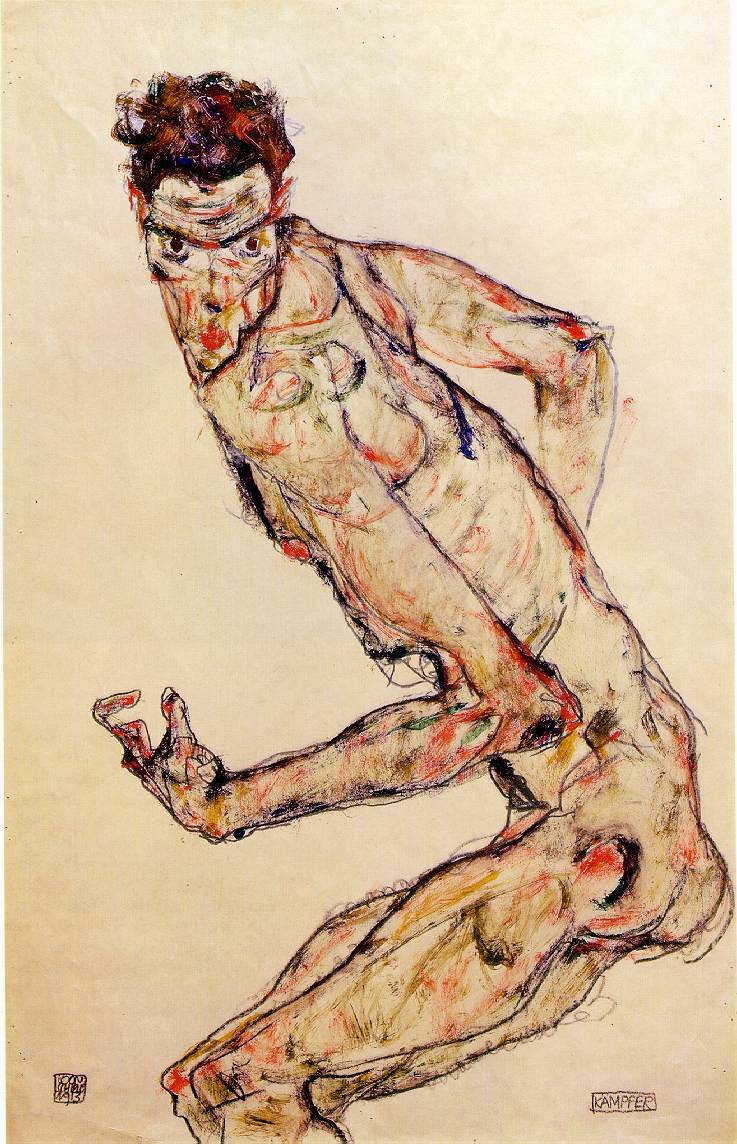
Egon Schiele “Le lutteur” 1913
Crayon et gouache sur papier 48,8 x32,2 cm © Coll. Part.
Today most of Schiele’s works are in Vienna’s Leopold Museum. From the private collection of Rudolf and Elisabeth Leopold, the couple sold several works by Schiele. Haüser bunter Wäsche (1914) was sold in 2011 for 27.6 million euros, while in 2013 three works on paper reached record sums for these media, sold for respectively 1.2 million euros, 6 million euros. euros and 9 million euros. Amongst the impressive auctions, today Egon Schiele work is still contested and rejected by detractors. What’s important to me is to keep in mind the slogan “To every age its art, to art its freedom” coming from the Viennese Secession.
«… I want to taste dark waters, squeaky trees, I want to see wild airs, to surprise me with decomposed fences, I want to live them, I want to hear young birch forests and quivering leaves, see light, from the sun and enjoy the bluish green of the wet valleys at dusk.»
 GRAPHIC TRAFIC